
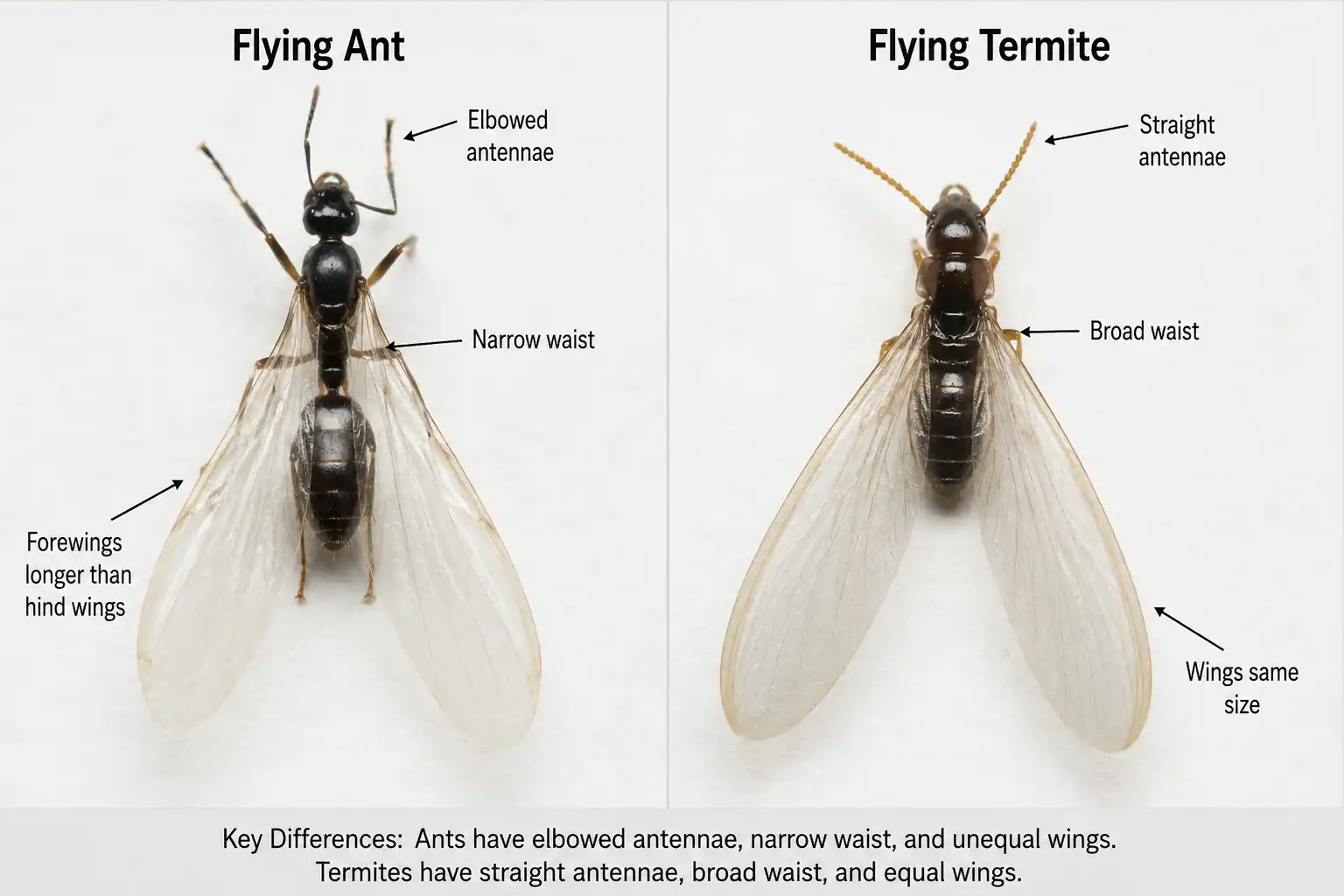
Flying Ant or Termite? The Quick Comparison
| Feature | Winged termite | Winged ant |
|---|---|---|
| Waist | Broad body without an obvious pinch | Clearly narrowed or pinched waist |
| Antennae | Straight to gently curved and bead-like | Distinctly bent or elbowed |
| Wings | Front and rear pairs approximately equal in length | Front wings noticeably larger than rear wings |
| After the flight | Often sheds wings readily | May retain wings for longer, although ants can also lose them |
Colour and size are less dependable on their own. Winged termites are often darker than the pale worker termites people imagine, while ants occur in many sizes and colours. Use the combination of body features rather than one characteristic.
What Does a Flying Termite Look Like?
Winged termites are reproductive members of a mature colony. They are often called alates or swarmers. Unlike worker termites, which generally remain concealed in soil, timber or shelter tubes, alates are built for a short dispersal flight.
The body looks fairly straight-sided, with no obvious narrow waist between the middle and abdomen. The antennae appear straight or softly curved rather than sharply elbowed. All four wings are long and close to the same size, often extending well beyond the body.
After landing, swarmers shed their wings and try to pair. This is why a homeowner may find loose, similarly sized wings without seeing many insects. A clear close-up photograph or collected specimen is more useful for identification than a description such as “small black flying bugs”.
What Does a Flying Ant Look Like?
Flying ants are the reproductive males and females produced by an established ant colony. The most obvious feature is the narrow waist that separates the body into distinct sections. Their antennae have a visible bend, and the front pair of wings is larger than the rear pair.
A winged ant indoors can still indicate a nest in or near the property, but the concern is different from subterranean termites feeding on structural timber. Correct identification matters because ant and termite treatments target different biology, nesting areas and routes.
Do not rely on the presence of wings alone. “Flying ants” is often used casually for any swarming insect, while winged termites are frequently called white ants even though termites are not ants.
Why Do Ants and Termites Suddenly Swarm?
Swarming is a reproductive event. A mature colony releases winged adults when conditions suit that species. Weather, temperature, moisture and time of day can all influence the flight.
In Gauteng, homeowners often notice swarms during warmer, rainy periods. Rain does not create a colony overnight; it can provide conditions that trigger already-developed winged insects to emerge. Different species do not all fly on exactly the same schedule, so avoid treating a particular month or rainfall event as a guaranteed identification.
Outdoor lights make a swarm more noticeable because many flying insects gather around them. A large number at a patio light may have come from outside the property. Insects appearing from a crack, skirting, door frame or another point inside the building deserve closer attention.
What Do Discarded Wings Mean?
A small pile of long, matching wings near a window, door or light can be evidence of a termite swarm. The insects may have flown in, landed and shed their wings, or they may have emerged from a concealed point within the building.
Location and repetition change the significance:
- A few insects at an open window after an outdoor swarm: they may simply have been attracted to indoor light.
- Large numbers emerging inside: this raises concern about an established colony or access route associated with the structure.
- Fresh wings returning to the same room: repeated evidence is more important than a single stray insect.
- Wings beside mud tubes or damaged timber: arrange an inspection rather than cleaning away every sign.
Wings alone cannot show whether timber has been damaged, how long activity has been present or where termites entered. They are a reason to investigate, not a complete diagnosis.
Other Signs That Point Towards Subterranean Termites
Flying termites are visible for a short time, while the working colony generally remains hidden. Look for supporting evidence around the property:
- narrow mud or soil tubes crossing foundations, brickwork, walls or timber;
- timber that sounds hollow or has a thin surface concealing galleries;
- door frames, skirtings or other wood that has become soft, blistered or unexpectedly damaged;
- soil-like material inside damaged wood;
- repeated swarmers or wings inside the home; and
- termite activity around tree stumps, timber landscaping or structures close to the house.
Some of these signs can have other causes. Swollen timber may be water damage, for example. Avoid breaking open a large area to check; disturbance can cause termites to retreat from the visible point and make the route harder to assess.
What to Do When You Find Winged Insects
Homeowner identification checklist
- Take close photographs from above and from the side before cleaning.
- Photograph the exact place where the insects or wings appeared.
- Keep several intact specimens in a small sealed container if practical.
- Check whether all four wings are similar in size.
- Look for a pinched waist and elbowed antennae.
- Note the time, recent weather and whether the swarm was indoors or outside.
- Check nearby foundations and timber for mud tubes or damage without breaking them open.
- Arrange identification if the features are unclear or the insects emerged indoors.
A vacuum can remove loose insects after photographs and samples have been taken, but it does not control a termite colony. Avoid pouring chemicals into cracks or spraying mud tubes before an inspection. The visible route can help the technician understand where activity is coming from.
When Should You Arrange a Termite Inspection?
An inspection is sensible when winged termites appear inside, swarmers seem to emerge from the building, wings repeatedly collect in the same area, or any swarm is accompanied by mud tubes or suspicious timber damage.
You should also get advice when the insects cannot be identified confidently. A photograph may be enough for an initial opinion, but an on-site inspection is needed to assess possible entry routes, moisture, concealed areas and the extent of any damage.
A swarm near the home does not automatically mean the building has an active infestation. Equally, killing the visible swarm does not prove that the risk has gone. The useful next step is calm identification followed by an inspection when the location or evidence warrants it.
Reducing Conditions That Hide Termite Activity
Keep slab and foundation edges visible where practical, repair persistent leaks and avoid piling timber, cardboard or firewood against exterior walls. Remove buried wood and old stumps where appropriate, and do not raise soil or garden beds over inspection edges.
These steps do not create a termite-proof home. They make concealed access and moisture problems less likely and help homeowners notice warning signs earlier. If the property has treatment records, keep them available and check before renovations disturb treated soil.
Not sure whether you found flying ants or termites?Send Essential Pest Control a clear photograph or arrange a termite inspection for your Gauteng home. We can identify the likely pest and recommend the next step without assuming every swarm requires treatment.
Send Us a PhotoFrequently Asked Questions
How can I tell a flying ant from a termite?
Check three features together. Termites have a broad waist, straighter bead-like antennae and four wings of approximately equal length. Ants have a narrow waist, elbowed antennae and larger front wings.
Do flying termites mean my house is infested?
Not always. They may have flown in from outdoors. Repeated indoor activity, emergence from the structure, discarded wings or other termite signs justify an inspection.
Why are there loose wings near my window?
Swarmers often gather near light and shed their wings after landing. Keep a sample and note whether the insects came through an open window or appeared from inside the building.
Should I spray a termite swarm?
Removing visible swarmers will not locate the colony. Photograph the insects, retain a specimen and avoid disturbing possible entry points before identification.