
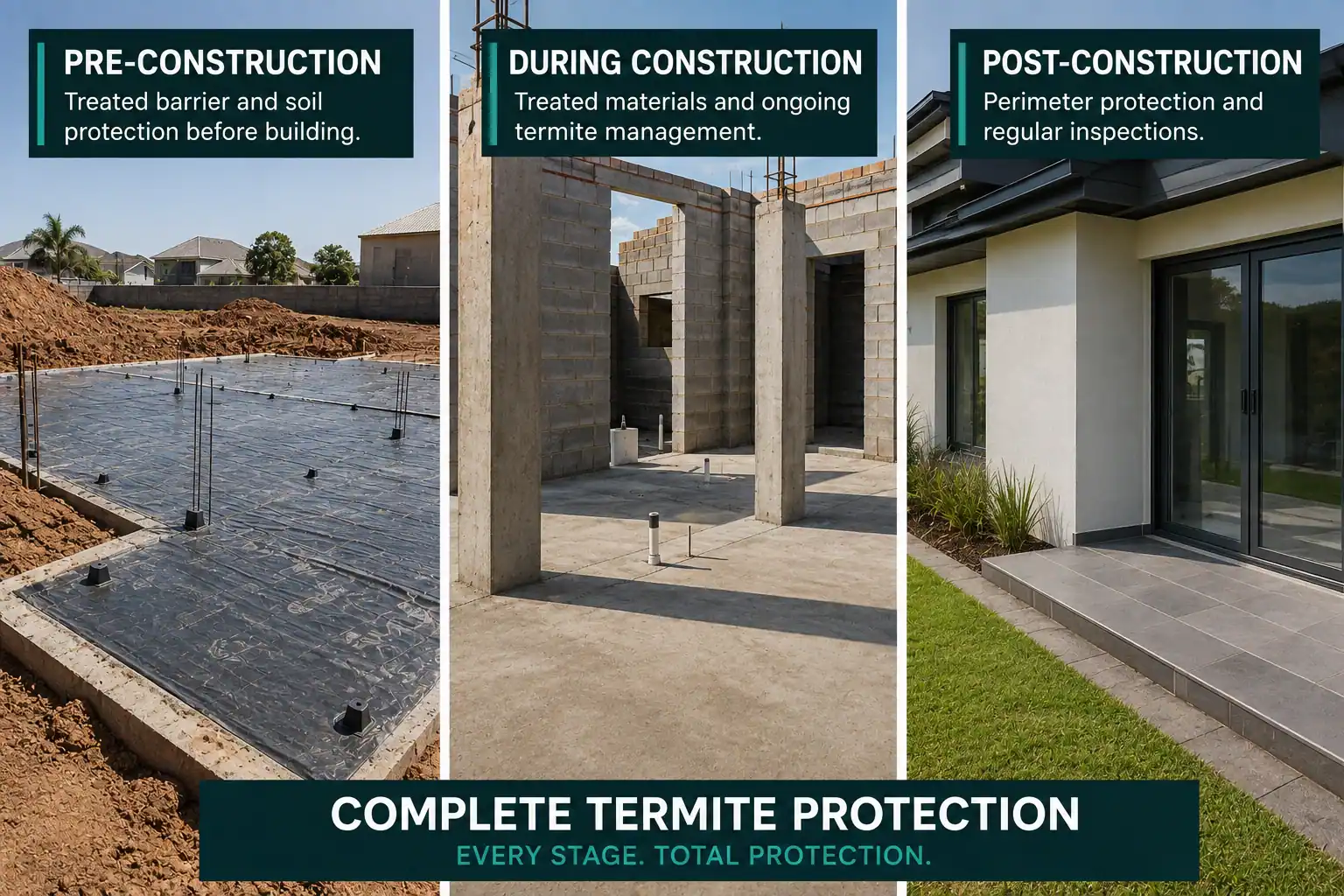
The Three Stages at a Glance
| Stage | When it happens | Main objective |
|---|---|---|
| Pre-construction | Before relevant foundations, slabs or soil areas are permanently covered | Plan protection while the building footprint and underlying soil are accessible. |
| During construction | At coordinated points as excavation, filling, services, slabs and external features progress | Complete each required treatment area and protect continuity as the design becomes physical. |
| Post-construction | After the building or addition has been completed | Investigate active or potential routes and establish treatment around accessible parts of the finished structure. |
These categories are not competing products. Pre- and during-construction work often form parts of one planned protection programme. Post-construction treatment is used when the building already exists, when activity is discovered later or when earlier protection has been disturbed or cannot be confirmed.
Pre-Construction Termite Protection
Pre-construction protection begins with planning. Before the relevant ground is concealed, the project team decides which areas need treatment, how the application fits the programme and what records will be required.
For conventional soil treatment, a registered termiticide is applied according to its approved label and the project specification. The purpose is to establish a treated zone between subterranean termites in the soil and likely concealed entry points into the building.
Why this stage offers the best access
Foundation trenches, compacted fill and service penetrations are visible. Treatment can follow the footprint without drilling through finished floors or lifting paving. The team can also remove buried timber, rubble and other material that could interfere with protection.
What must be decided early
The provider needs the foundation and floor layout, measurable areas, construction sequence and project requirements. The quotation should state which stages and areas are included. “Soil poisoning” written as one line in a budget is not enough to coordinate a multi-phase site.
Pre-construction protection does not mean treating loose ground months before the slab is ready. Application must align with the approved method, product label and site conditions so that the treated zone can be protected and covered in the correct sequence.
During-Construction Termite Protection
During-construction protection is the delivery and preservation of the planned system as work progresses. A provider may need to attend at different stages because not every relevant area becomes ready at once.
Depending on the design and specification, this may include attention to completed foundation excavations, prepared under-slab soil, service penetrations, construction joints, slab edges, entrance steps or adjoining external slabs. The exact method must follow the project details rather than a generic checklist.
Coordination with other trades
The site manager plays a central role. Excavation and compaction should be complete, services should be in their final positions and rubble should be removed before treatment. Concrete, membranes and follow-on work must then be sequenced without unnecessarily disturbing the area.
A plumber cutting a late trench or a team adding untreated fill can interrupt a previously treated zone. That does not always mean the entire project must be redone, but the affected area should be identified and corrected before it disappears beneath concrete.
Changes and phased developments
Revised layouts, extensions and phased pours must reach the pest-control provider. A marked-up drawing and treatment log help distinguish completed, outstanding and changed areas. This is particularly important for estates, warehouses and multi-unit developments where several structures may be at different stages.
Post-Construction Termite Protection
Post-construction treatment applies once access beneath the building has closed. It may be preventative where no reliable treatment record exists, or remedial when termite activity has been found.
The process starts with inspection. Mud tubes, damaged timber or winged termites may reveal activity, but the technician also needs to consider slab edges, cracks, service entries, damp areas, additions and landscaping. The visible damage may be some distance from the point where termites entered.
How treatment differs in a finished building
Because the soil is covered, treatment may require carefully positioned drilling, trenching around accessible perimeters, injection into relevant areas or another method suited to the structure and product. It is inherently more constrained than treating exposed soil.
Drilling should never be described as a fixed grid applied blindly. The provider must consider plumbing, electrical services, waterproofing, floor finishes and structural details before work begins. Occupants also need clear preparation, access and re-entry instructions.
Post-treatment repairs
Damaged timber should not be replaced before the activity and likely route are assessed. Treatment controls the pest; it does not restore structural strength. Where damage may affect a load-bearing component, the owner should obtain advice from a suitably qualified building professional.
A note on specifications and standards
South African project specifications may require anti-termite soil treatment, a registered provider and treatment documentation, and construction documents commonly reference SANS 10124 for soil insecticide application against termites.
The correct requirement depends on the project, approved plans, contract, local authority, treatment method and current product label. Confirm the applicable standard and certificate requirements with the principal agent or relevant construction professional. This guide does not replace a site-specific specification.
Which Stage Applies to Your Property?
A simple starting point
- The build has not reached foundations: include termite protection in planning, pricing and the programme now.
- Foundations or slabs are under way: arrange an immediate site review to identify what remains accessible and what has already been covered.
- The building is complete with no known activity: review available certificates, later alterations and current risk before deciding on inspection or preventative work.
- Termites or damage are visible: arrange a professional inspection before disturbing mud tubes or removing damaged material.
- An extension is being added: treat it as new construction while also checking how it joins the existing building.
If a construction stage was missed, do not assume that nothing can be done. The available method changes as access closes, so early advice creates more options.
Why Continuity Matters More Than a Single Treatment Date
Subterranean termites exploit gaps. A well-treated slab area can still be undermined by an untreated service trench, an added patio that conceals the inspection edge or soil moved against the building after completion.
Continuity means considering the whole route around and beneath the structure. The builder, pest-control provider and project manager must communicate about penetrations, joints, level changes and later additions. It also means reporting disturbance instead of covering it and hoping the original certificate is enough.
The same principle continues after handover. Irrigation leaks, poor drainage, timber stored against walls and gardens raised over slab edges can create favourable conditions or hide signs that would otherwise be noticed early.
What Should Be Recorded and Handed Over?
A useful termite-protection file should identify the site, dates, construction stages and areas treated. It may include the product and registration information, application details required by the label, measured quantities, photographs, marked plans, limitations, corrective work and the provider's certificate or guarantee terms where applicable.
Records serve different audiences. The contractor needs evidence for project close-out, the developer needs an accurate account of the scope, and the future owner or property manager needs to know what alterations could affect protection. Vague paperwork that says only “termite treatment completed” cannot answer those questions.
Common Misunderstandings to Avoid
| Misunderstanding | More accurate view |
|---|---|
| Pre-construction treatment is one visit | The design and programme may require several coordinated stages. |
| A clear stand has no termites | Colonies and routes may remain underground even without a visible mound. |
| A certificate protects any later change | New trenches, additions and disturbed soil may need separate attention. |
| Post-construction work is identical | Finished buildings restrict access and require investigative, structure-specific methods. |
| Treatment repairs timber | Pest control addresses activity; damaged building materials may require professional repair. |
| Protection lasts forever | Products and guarantees have conditions, and buildings continue to change after handover. |
A Practical Approach for Gauteng Properties
Gauteng projects range from individual homes and townhouse developments to warehouses, schools and commercial buildings. Site conditions, foundation systems and construction programmes differ, so the treatment scope should be designed around the actual build.
The most reliable approach is simple: plan before access closes, coordinate each construction stage, record exactly what was completed and continue inspecting the property after occupation.
Need termite protection at any stage of a project?Essential Pest Control provides pre-, during- and post-construction termite services for homes, developments and commercial properties across Gauteng.
Request a Free QuoteFrequently Asked Questions
What is the difference between pre- and during-construction protection?
Pre-construction protection covers planning before relevant work begins. During-construction protection is the coordinated application, checking and repair completed as foundations, soil, services and slabs progress.
Can a finished building still be treated?
Yes. Post-construction methods can address accessible soil and likely entry routes, but the work is more constrained and should begin with a detailed inspection.
What if the original treatment certificate is missing?
Ask the developer, contractor, previous owner or managing agent for project records. If the scope cannot be confirmed, an inspection can assess current risk, visible evidence and practical options.
Does termite treatment last forever?
No. Product life, site conditions, later alterations, moisture and landscaping all matter. Follow the provider's written terms and retain inspection and treatment records.